"DISCLOSURE DAY" - REVIEW
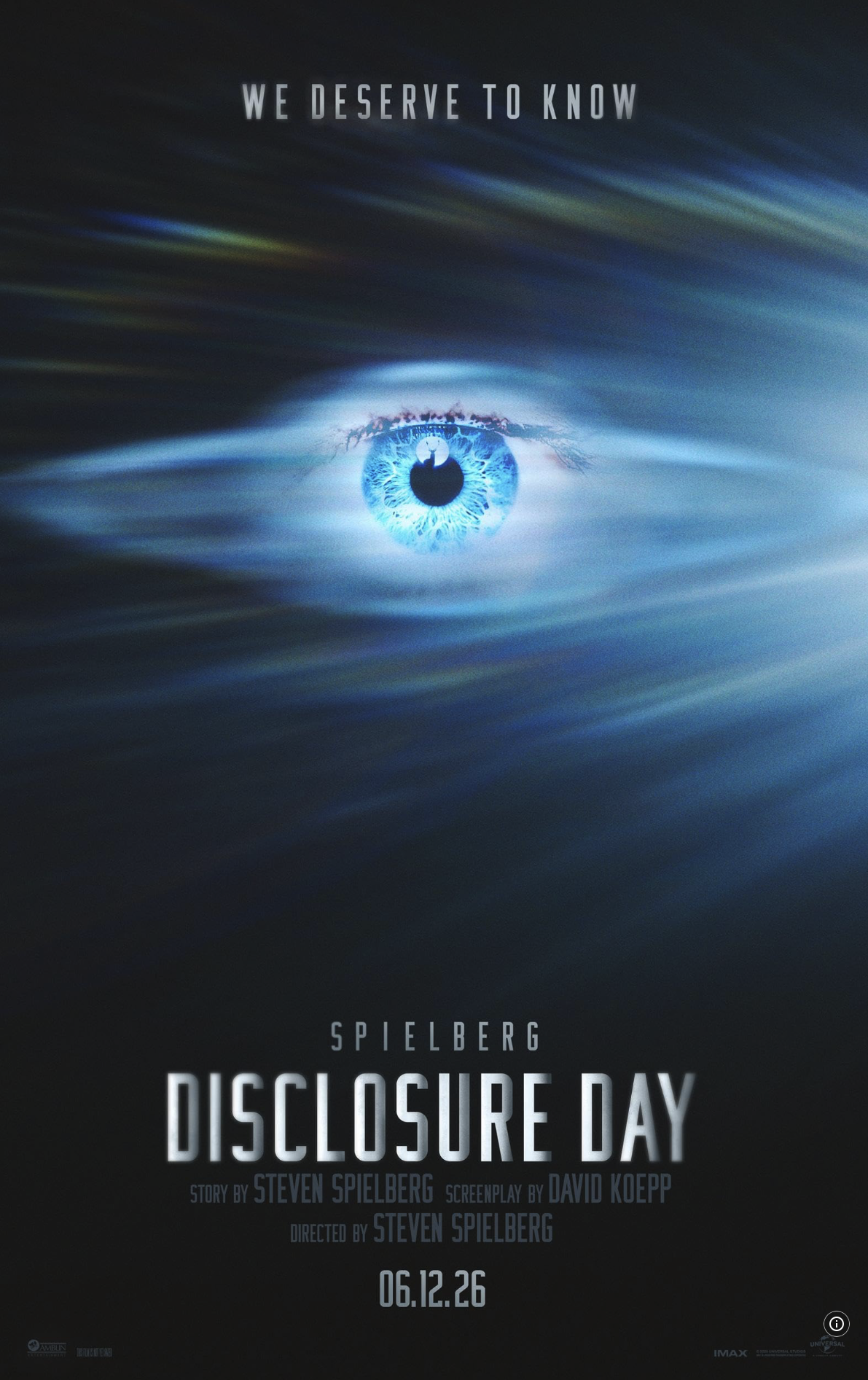
Once again, we are not alone, and as the simultaneously thrilling and perplexing DISCLOSURE DAY illustrates, on multiple levels, we never were.
On one hand, it’s a blast to have Steven Spielberg back serving up a big brainy blockbuster for summer audiences. At 79 years old, he is still the best to ever do it. In his first film in four years (THE FABELMANS, which I adored) and perhaps his most exciting movie in years, he more or less riffs on, well, Spielberg movies. But what kind? Which Spielberg are we getting here?
In these trying times, thankfully, DISCLOSURE DAY is not like his last major sci-fi film, 2005’s lean, mean and dreary 9/11 allegory WAR OF THE WORLDS. It possesses very little of his late-period professorial tendencies. Instead, it is a chase thriller that I’d call a “fast-paced slow-burn”: very cagey (or so it thinks) with what it’s about for almost two thirds of its 2 hours and 25 minutes, but very energetic with how it is about it.
In a spoiler-free nutshell, DISCLOSURE DAY involves a government conspiracy in which Dr. Daniel Kellner (Josh O’Connor) steals information from the top-secret corporation he works for; Noah Scanlon (Colin Firth) is the leader of said agency in hot pursuit of Kellner; and lastly and most importantly, Margaret Fairchild (Emily Blunt, who gives a performance for the ages), a Kansas City weatherwoman who wakes up one morning with sudden and mysterious linguistic abilities and empathic understandings of perfect strangers; and Hugo Wakefield (Colman Domingo), who will bring them all together to finally reveal THE TRUTH, in a world on the brink of World War Three.
In what feels like a mix between the weird warm wonder of CLOSE ENCOUNTERS OF THE THIRD KIND and the kinetic cold steel of MINORITY REPORT, DISCLOSURE DAY is one of Spielberg’s weirdest and most eclectic movies. Moment-to-moment unpredictable, it features several bravura thrill-ride sequences as a conduit for its big ideas… which is why that last third is a bit of a letdown.
How so? Without getting into details (I promise), regular collaborator David Koepp’s screenplay (from a story by Spielberg) introduces many characters whom, largely thanks to the actors, just barely breach the surface of being mere plot and idea functionaries, as well as many seemingly disparate narrative and thematic threads that frustratingly ride the razor’s edge between the literal and the ethereal in its effort to resolve them. Yes, that is the nature of faith. Yes, that is the mystery of the universe. But the attempt to half-literalize some of it but not all, and not in the right proportions, can be unsatisfying. The feeling Spielberg is going for is something I understood intellectually, but seldom felt.
At this point you may be thinking I didn’t like DISCLOSURE DAY.
It might possibly be one of the year’s best movies, and certainly one (I hope) that can’t be distilled in one viewing. A big-budget arthouse film perhaps, DISCLOSURE DAY boasts impeccable craft as Spielberg brings back production designer Adam Stockhausen, costume designer Paul Tazewell, editor Sarah Broshar, and of course, in their 30th film, composer John Williams with subtle but stirring themes to tie it all together. It features an exciting and dynamic cast that also includes Wyatt Russell, Eve Hewson, Elizabeth Marvel and a slew of “that–persons” that you’ll be happy to see, like Hettienne Park (YOUNG ADULT, DON’T LOOK UP) and Jeremy Shamos (BIRDMAN, BETTER CALL SAUL). Philosophically, it features a refreshingly insatiable curiosity about the nature of faith as it pertains to the mysteries of the universe. Again, I understand. I just wanted to feel it. But as a summer entertainment, in terms of its philosophical undertones, maybe the film, to borrow an OKLAHOMA! lyric about Margaret’s city, just “goes about as fer as it can go?”
Another reason I didn’t feel it could be this: Ever since Spielberg began his collaboration with cinematographer Janusz Kaminski (who has lensed every one of his films since 1993’s SCHINDLER’S LIST), and perhaps since making one of his most polarizing films, 2001’s A.I.: ARTIFICIAL INTELLIGENCE (which he took on following the death of Stanley Kubrick in 1999), Spielberg has adopted a colder aesthetic, which I find to be at odds with the warmth he means to convey. Perhaps that’s just the world we live in now, and the warmth is working hard to penetrate the cracks of cold cynicism… or perhaps it’s a way of justifying a cinematography style that Spielberg has obviously fallen in love with over the past 30 years, whether it’s appropriate for the project or not (thankfully, Colman Domingo is here to supply much of the film’s warmth as well as much of the film’s third act exposition. As a colleague said in his review, “Domingo is very good at delivering long monologues”).
Bottom line, for better or worse, DISCLOSURE DAY may have something for everyone. You may find it to be a nice escape from the heat, with a tub of popcorn in your lap. I personally found a lot to admire, but don’t expect to be blown away. But it’s not one that I want to write off either. Mid-tier Spielberg is still something I want to watch again and wrestle with a bit. I will always favor a big swing and not quite getting there over aiming low and hitting the target. I think this is what Spielberg wants: to entertain, to make us think and, as Margaret finally asks us, to “listen.”
#moviefriend
#disclosureday
#stevenspielberg
#universalpictures
#amblinentertainment
#emilyblunt
#joshoconnor
#colinfirth
#colmandomingo
#evehewson
#wyattrussell
#henrylloydhughes
#elizabethmarvel
#hettiennepark
#davidkoepp
@mncritics
Zach is a proud member of the Minnesota Film Critics Association (MNFCA). For more info about Zach, the organization, or to read other great reviews from other great Minnesota-based film critics, click here: www.mnfca.com